


Part 2 - Fellowship - Its Meaning, Foundation, & Responsibility

Updated: Mar 26
By request, we give a Part 2 of our "Fellowship" talk to carry the concepts from the first exhortation into practical application, addressing questions like
- What does it mean and communicate to others if we withhold the emblems from them?
- What does disfellowship mean and communicate?
- What questions should we ask when considering whether to break bread with a large group of people who we don't intimately know (like a Bible School)?
And more.
You can watch the presentation below, or you can print or read a readable copy of it by scrolling past the video. If you have not watched/heard Part 1, it will be helpful to do so - Part 1 - Fellowship - Its Meaning, Foundation, & Responsibility.
Note: This exhortation was given at our home ecclesia but partially intended for a larger audience. We humbly invite correspondence on this subject for any who have questions.
PART 2 - Fellowship – It’s Meaning, Foundation, & Responsibility
I received requests for a follow up talk on fellowship to carry the concepts from the first talk onto some practical applications and questions of our day. The questions we’re going to attempt to address are
- What does withholding the emblems mean and indicate?
- What should our mindset be at the memorial table?
- On what principles should we break bread with a large group of people, many of whom we do not intimately know (Bible schools)?
Let’s first review, and as we do so, we’ll delve further into some of these subjects. I want to acknowledge that these are oftentimes controversial and difficult subjects. The difficulty doesn’t arise from discerning what the Scriptures teach – it arises from applying it, particularly when we have family and friends involved. But we must ask ourselves, “What is it that I am seeking? Who am I trying to please?” As Paul says, “… If I yet pleased men, I should not be the servant of Christ” (Galatians 1:10).
Review
Fellowship with God, and Therefore Each Other
We saw that fellowship means “partnership, joined together”, and that fellowship is a relationship. Fellowship is not an activity or an action, but there are certain things we do with those we have fellowship with. Fellowship is NOT just breaking bread. In fact, we can rightly say that breaking bread is not fellowship, but we should only break bread with those who we have fellowship with. We saw a distinction between fellowship and breaking of bread in Acts 2:42.
The most important concept is that we only have fellowship with one another because each of us individually has fellowship with God as seen below. The first image shows our relationship while in Adam, and the second shows the change we undergo by entering into Christ.
Our relationship with God is therefore the basis of our relationship with each other, and the impact of this is not often considered, particularly when the emblems are refused. When the individual enters into covenant through baptism, they are made a son/daughter of God and a brother/sister of Jesus Christ. In becoming part of God’s spiritual family as an adopted son and daughter, they are now related to all others who have become part of God’s spiritual family. There are three passages I want to read which summarize this. Since we talked about this in the first talk, we won’t comment upon them:
Galatians 4:4-7 – But when the fulness of the time was come, God sent forth his Son, made of a woman, made under the law, (5) To redeem them that were under the law, that we might receive the adoption of sons. (6) And because ye are sons, God hath sent forth the Spirit of his Son into your hearts, crying, Abba, Father. (7) Wherefore thou art no more a servant, but a son; and if a son, then an heir of God through Christ.
Hebrews 2:10-11 – For it became him, for whom are all things, and by whom are all things, in bringing many sons unto glory, to make the captain of their salvation perfect through sufferings. (11) For both he that sanctifieth and they who are sanctified are all of one: for which cause he is not ashamed to call them brethren,
1 John 1:3 – That which we have seen and heard declare we unto you, that ye also may have fellowship with us: and truly our fellowship is with the Father, and with his Son Jesus Christ.
Again - our fellowship with God is the only basis on which we have fellowship with one another. Either someone has fellowship with God and therefore us or they do not.
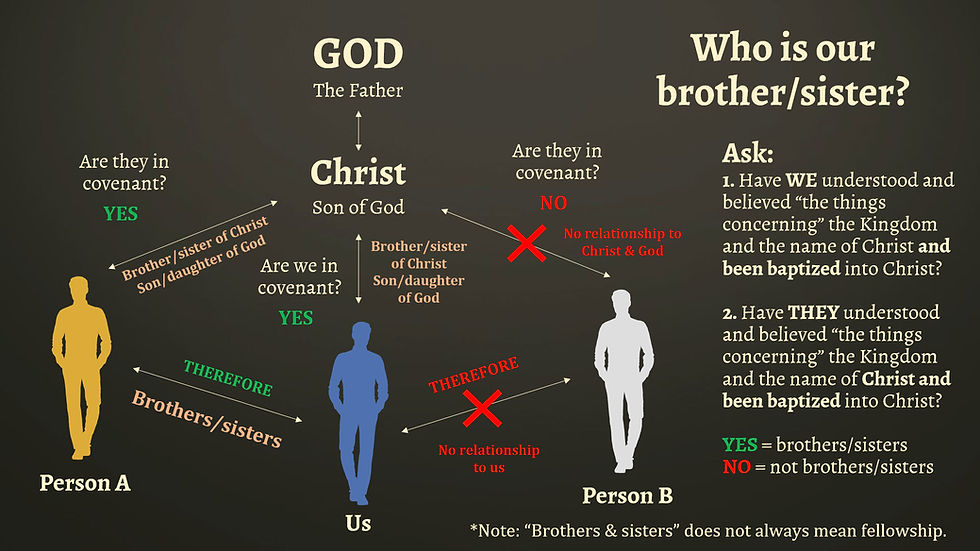
I’m emphasizing this because there’s a lot of “murkiness” surrounding this subject, and it’s often handled in a very opinion-based way which contradicts this principle. People can be disfellowshipped or refused the emblems, but the refusers will rarely go so far as to say that the person no longer has fellowship with God. This is a great contradiction. If we have fellowship with God, we cannot control who is our brother or sister. Using the example of adoption – if we are adopted into a family, we can’t control who now becomes our brother or sister. We may not like them, but this does not change the fact that we are part of the same family and therefore have a sibling relationship. The same applies to when we become part of God’s spiritual family. This is God’s plan and process, and the only say we have in it is whether we want to be a part of it or not. We cannot create our own criteria for this. There are two things we must consider when talking about the emblems: being brethren and having fellowship.
If we’re wondering whether someone is a brother or sister or not, the only questions we need to ask are – Did the person come to a sound understanding of the first principles of the truth, and did they then enter into covenant through baptism? If the answer is “Yes”, they are brethren and we have fellowship with them as long as they hold fast to sound principles and are trying to keep the covenant they made. If the answer is “No”, then they are not brethren. By “sound understanding of the truth”, we refer to the principles of the Unamended Statement of Faith. See the chart below for an illustration:
Yet there is unfortunately the possibility for people to walk away from their covenant with God, and this is where we get to disfellowship.
Disfellowship & Withholding Emblems
Being a brother/sister is a prerequisite of having fellowship. Since man cannot exit covenant, they cannot change their legal relationship to no longer being a son/daughter of God and brother/sister of Christ. This relationship exists for the rest of their life.
But brothers/sisters can lose fellowship with God by fall away and abandon their end of the covenant, no longer walking with God. Remember – “fellowship” means “partnership, joined together”. Disfellowship is the cessation of that relationship and indicates two parties working together. If one party is no longer working in the relationship, it is not fellowship.
Fellowship can be lost by either falling away from the sound principles of the truth or by walking contrary to the covenant they made. If they do either of these things, they therefore no longer have fellowship with God even though the legal relationship still exists. We’ll refer to these as “believing and walking” for our purpose here.
That we can be brethren but not have fellowship any longer is evident in Scripture:
1 Corinthians 5:9-13 – I wrote unto you in an epistle not to company with fornicators: (10) Yet not altogether with the fornicators of this world, or with the covetous, or extortioners, or with idolaters; for then must ye needs go out of the world. (11) But now I have written unto you not to keep company, if any man that is called a brother be a fornicator, or covetous, or an idolater, or a railer, or a drunkard, or an extortioner; with such an one no not to eat. (12) For what have I to do to judge them also that are without? do not ye judge them that are within? (13) But them that are without God judgeth. Therefore put away from among yourselves that wicked person.
Such a brother has returned to the ways of the flesh and shows no signs of repenting. They are not walking according to the covenant they made, so while Paul still calls them a brother, they no longer have fellowship with God and us. Please note how series this is though. By saying one no longer has fellowship with God, we are communicating that they, as far as we are able to reason from Scripture, have abandoned the way of life. They will certainly stand before Christ though. Christ alone is the judge who will give their sentence, but we have been given instruction to put them out from us if this is the case. The process for disfellowship is given to us in
Matthew 18:15-17 - Moreover if thy brother shall trespass against thee, go and tell him his fault between thee and him alone: if he shall hear thee, thou hast gained thy brother. (16) But if he will not hear thee, then take with thee one or two more, that in the mouth of two or three witnesses every word may be established. (17) And if he shall neglect to hear them, tell it unto the church: but if he neglect to hear the church, let him be unto thee as an heathen man and a publican.
This is not to be done lightly, and this process must be followed as it is a very serious matter. So how do we know whether we have fellowship with a brother or sister or not? We need to ask these two questions
1. Do I still believe sound doctrine and am striving to keep my end of the covenant?
2. Do THEY still believe sound doctrine and are striving to keep their end of the covenant?
See the illustration below to demonstrate.

We must emphasize which part of this equation matters. It all starts with one’s relationship with God and Christ. You and I have no power over whether someone has fellowship with God - that is between God and the individual. If, therefore, they have fellowship with God (as far as we can discern), then they have fellowship with us. See the chart below:

We must ask ourselves – How have we gone about this subject? Have we been too liberal or too strict with who we call brethren and have fellowship with? I’ve heard it said before that people will refer to others with different beliefs as brothers and sisters because they think it’s rude not to and don’t want to hurt feelings. I understand the motive, but this is putting people’s feelings over the laws of God. For those who have believed and been baptized, they are sanctified of God – they are special to Him and have been set aside for His purpose. Those who have not done these things have not been set apart, and that is not for us to decide. It can often be seen as a “small thing” to call one another brethren, but it’s truly one of the most lofty, important parts of salvation because those titles are showing our relationship to life in Christ and participation in God’s plan. Again,
Hebrews 2:10-11 – For it became him, for whom are all things, and by whom are all things, in bringing many sons unto glory, to make the captain of their salvation perfect through sufferings. (11) For both he that sanctifieth and they who are sanctified are all of one: for which cause he is not ashamed to call them brethren,
If we aren’t sure if someone believed the truth as summarized in our Unamended Statement of Faith and was baptized, we should ask them. This doesn’t mean interrogating every person we meet, but it does mean using discernment and gravity when using this title. It conveys much.
Origin, Purpose, and Regulations of the Memorial Table
With those principles established, let’s direct our attention back to the memorial service. Last time, we saw how the memorial service Christ gave us came from the Passover feast, and that fact answers many questions we often have about the Lord’s table. While Israel was in Egypt and the death sentence passed upon all of the firstborns, God bought and redeemed Israel out of Egypt by the blood of the Passover lamb. For any who followed God’s process and associated themselves with the body and blood of the lamb, the sentence of death was removed from them. They were redeemed and freed, and God therefore commanded Israel to keep the Passover feast forever as a memorial to this.
Exodus 12:14, 26-27 – And this day shall be unto you for a memorial; and ye shall keep it a feast to the LORD throughout your generations; ye shall keep it a feast by an ordinance for ever. (26) And it shall come to pass, when your children shall say unto you, What mean ye by this service? (27) That ye shall say, It is the sacrifice of the LORD'S passover, who passed over the houses of the children of Israel in Egypt, when he smote the Egyptians, and delivered our houses…
They were redeemed and given new life because of this blood, and observing the Passover feast was a testimony and reminder of how they were bought and freed, and they were therefore commanded to partake of the emblems – it was not optional. This is why we are commanded to partake of the emblems today. Anyone who is baptized has been redeemed through Christ’s body and blood, and he commanded us to partake of these emblems on the same basis as the Jews did the Passover emblems. We read in
1 Corinthians 11:24-26 – And when he (Jesus) had given thanks, he brake it, and said, Take, eat: this is my body, which is broken for you: this do in remembrance of me. (25) After the same manner also he took the cup, when he had supped, saying, This cup is the new covenant in my blood: this do ye, as oft as ye drink it, in remembrance of me. (26) For as often as ye eat this bread, and drink this cup, ye do shew (proclaim, promulgate) the Lord's death till he come.
Strangers Not to Partake
The next verse (vs 27) mentions that drinking unworthily brings condemnation to one’s self, and we saw how that at least partially referred to strangers. In the commandments concerning Passover, strangers – those who were not a citizen or part of Israel – were NOT allowed to partake of the Passover feast unless they first became part of Israel through circumcision. After they were circumcised and part of Israel, there was no distinction between Jew and stranger (Exodus 12:43-49).
Exodus 12:48 – And when a stranger shall sojourn with thee, and will keep the passover to the LORD, let all his males be circumcised, and then let him come near and keep it; and he shall be as one that is born in the land: for no uncircumcised person shall eat thereof…
This is exactly the same process that we see with us today. “Foreigners” and “Gentiles’ can enter into covenant through baptism, after which, we are told
Colossians 3:11 – Where (in Christ) there is neither Greek nor Jew, circumcision nor uncircumcision, Barbarian, Scythian, bond nor free: but Christ is all, and in all. (See also Galatians 3:36-39).
Covenant relationship is how man can become part of God’s people and participate in Passover. This is how it has always been.
Why does God prevent strangers from participation in Passover? It’s because the Passover feast was to cause Israel to remember the means through which they were redeemed and escaped the death sentence. It was both a lesson and encouragement – that they indeed did have new life because of that lamb. But anyone who did not associate themselves with the Passover was not redeemed, stayed under condemnation of death, and they had no relation or claim to the emblems. The principle is the same today as it was back then.
Please take careful note that there is no middle ground. Either someone is part of Israel or they are not, and this same rule applies today as we have seen. Either someone is in Christ or they are in Adam. If someone is not baptized or did not have sound understanding and belief at their baptisms, they are not in covenant, and we therefore cannot extend the emblems to them.
This is not our rule – it is God’s rule. Allowing “strangers” to partake of the emblems is a direct violation of God’s law, and it’s a violation because allowing strangers teaches that man can be reconciled to God and escape the condemnation to death without association to the blood of Christ. Note this well. Allowing strangers to partake of the emblems signifies that man can escape death without the blood of Christ and covenant relationship through it.
Let’s look more at the emblems, specifically their use and misuse.
The Emblems – Use & Misuse
Studying this subject has shown me that we often take many liberties with the emblems. What I mean is that many tend to infuse their own personal meaning into the emblems and why we might not partake of them. This is particularly seen when we consider the basis on which the emblems are often refused to brethren. We touched on that earlier with fellowship, but let’s look at it more.
But before we focus on those things, I want to ask a question relating to mindset: When we think of our Sunday services, what is the “height” of our service? It’s not the exhortation, the hymns, though those are important. It should be the memorial service. To partake of these emblems is the main reason we meet. Christ didn’t command us to have a memory verse, say the books of the Bible, or do an exhortation as oft as we meet. Those have been added by us for our benefit. He commanded us to partake of the emblems to remind and recommit ourselves to the covenant we made through what the emblems represent – the body and blood of Christ. When we take of the bread and wine, we should remind ourselves that this is why we are here. It’s so easy to just go through the motions and think about other things, but what the emblems should do is cause us to think back to two events:
1. The offering and sacrifice of Christ around 2,000 years ago
2. Our baptism
These emblems point to when Christ offered himself so we could be partakers of God’s plan. But we should also think back to the day of our baptism because that’s when we as an individual entered into covenant and were grafted into God’s family. That is the moment when we formed fellowship with God. Christ’s offering was when true life was made possible, but our baptism is when we associated ourselves with it.
In thinking of our baptisms, we should think back to what we thought and felt as we came up out of the waters free from any condemnation. Go back to that day – How did we feel when we arose? This was the most significant event in our life. We were given a completely clean slate because of Christ, and this should humble us because we did not deserve it, it should exhort us because we were now bought with the blood of Christ and are not our own, and it should encourage us because we have new life, and we have a mediator who sits on the right hand of God to intercede for us. Partaking of the emblems is a reminder and a recommitment, and these concepts are bound up in what Paul terms “examining ourselves” and “discerning the Lord’s body” (Corinthians 11:28-29).
But why would we choose to refrain from the emblems? I think we tend to reason, “I haven’t been walking correctly lately” or “I have not been in a good mindset lately”, and we reason that we are not worthy of the emblems. We can make our own decision, but I believe by refraining in these circumstances, we can be missing the point.
It’s at those times that we need the reminder of the covenant we have made. We must remember that it’s a command to partake, and we clearly see this in the law of Moses concerning Passover in Numbers 9. There were men who had touched a dead body and were therefore “unclean”, and they asked Moses whether they should partake of the Passover. We read in
Numbers 9:9-12 – And the LORD spake unto Moses, saying, (10) Speak unto the children of Israel, saying, If any man of you or of your posterity shall be unclean by reason of a dead body, or be in a journey afar off, yet he shall keep the passover unto the LORD. (11) The fourteenth day of the second month at even they shall keep it, and eat it with unleavened bread and bitter herbs. (12) They shall leave none of it unto the morning, nor break any bone of it: according to all the ordinances of the passover they shall keep it.
Nobody who was part of Israel was exempted from this, even though they were “unclean”. But the unclean did have to wait a month before partaking because the defilement period ran longer than Passover did. We can therefore see a reason for refraining from the emblems on a particular day if we are truly “unclean”, but are we “unclean”? Let us think on it deeply before we refrain, because under the law, there was a severe penalty for not partaking when someone should have. We see this in the next verse:
Numbers 9:13 – But the man that is clean, and is not in a journey, and forbeareth to keep the passover, even the same soul shall be cut off from among his people: because he brought not the offering of the LORD in his appointed season, that man shall bear his sin.
The memorial service should work upon our minds and spirits regardless of how we inwardly feel at the time. If we feel like we have been “doing well” lately, let the emblems be a source of joy and the quiet exhortation of 1 Corinthians 10:12, “let him that thinketh he standeth take heed lest he fall.” If we feel like we haven’t been obedient or have sensed ourselves straying, let them remind us that we were purchased by Christ’s own blood, and we are not our own. Let it "whip us back into shape".
Basis for Refraining – “Eating Unworthily”
It’s worth mentioning that Paul does talk about eating unworthily. We are familiar with the passage:
1 Corinthians 11:27-29 – Wherefore whosoever shall eat this bread, and drink this cup of the Lord, unworthily, shall be guilty of the body and blood of the Lord. (28) But let a man examine himself, and so let him eat of that bread, and drink of that cup. (29) For he that eateth and drinketh unworthily, eateth and drinketh damnation to himself, not discerning the Lord's body.
By partaking unworthily, a man can drink condemnation only to himself. But what does “unworthily” consist of? Paul doesn’t clearly spell it out, but the context indicates that it relates to examining ourselves and discerning the Lord’s body. It seems to mean taking the memorial service lightly. Just “going through the motions”, not thinking about Christ, and not looking inwardly all constitute “unworthily”. If we are not made better by it in some way and it becomes just a mere eating and drinking, then we are not giving it proper emphasis. If we partake and then continue with our sinful ways with no resolve to change, then what good are the emblems doing us? What I want to caution is giving too many excuses for refraining from the emblems.
Withholding the Emblems
So those are some reasons why we might choose to refrain ourselves from the table, but what about when we choose to withhold emblems from others? This is a very different thing. We must ask - If we are refusing the emblems to someone, can we clearly and concisely explain why, citing chapter and verse?
A study of this subject has made it apparent that this matter is often dealt with on uncertain, vague grounds. The absolute seriousness of refusing emblems is often lost. Again – these emblems are the token that all of us have been bought by the blood of Christ and that we are striving to walk in accordance with God’s ways. But some have seemed to use the emblems as a part of a “club” that can be easily and lightly refused without any great significance. It’s also strange that withholding the emblems has somehow been disconnected from disfellowship, and this is putting many things in the wrong place.
If we are going to fellowship someone, then we fully associate with them. We attend meetings and certainly share the emblems with them. But what does withholding the emblems actually teach? What does it mean on the party which is being refused? Let’s put it in a scenario concerning Israel and the Passover feast since these are the same ceremony:
What would it communicate for an Israelite to withhold the Passover emblems from another Israelite? We saw that those who were unclean for having touched a dead body had to wait until the next month to observe Passover, but that’s only because they were unclean at the time of Passover. What we’re talking about is complete refusal. The only reason we’re given (that I’ve found) for refusing those emblems is if the individual is a stranger like we read in
Exodus 12:43, 45, 48 – And the LORD said unto Moses and Aaron, This is the ordinance of the passover: There shall no stranger eat thereof… (45) A foreigner and an hired servant shall not eat thereof… (48) And when a stranger shall sojourn with thee, and will keep the passover to the LORD, let all his males be circumcised, and then let him come near and keep it; and he shall be as one that is born in the land: for no uncircumcised person shall eat thereof…
Only strangers were continually refused the emblems. So if we refuse the emblems to people who we know are brethren, what does this communicate? It’s treating them like a stranger who is not in covenant or an Israelite who has abandoned it. It shows that the individual is not a part of Israel. It’s the same exact concept we saw earlier with us. If we are in covenant but now believe or act like strangers, we do not have fellowship with God and therefore partake of the emblems unworthily.
Is that how we view the person we are refusing emblems to? Is this what we mean to convey? If so, then it is the course of action. If not, then we need to think carefully.
We cannot make up our own rules about what withholding the emblems means. We’ve seen brothers and sisters who have refused the emblems to people for any number of reasons, but when the person asks, “What does this mean for me now that I can’t partake of the emblems? What does this say about my salvation??” the withholders trip over themselves trying to give a clear answer. Few will go the full distance and tell the person, “We believe you don’t have fellowship with God.” That’s a bold statement as it should be, yet while this is not stated out loud, it is indicated by refusing emblems.
Others make up their own answer, saying things like, “We ask you to refrain for our sakes.” Does this not indicate that by that brother/sister partaking, the rest of the group is the worse for it? Such is certainly not taught in Scripture.
But some will say, “We won’t completely disfellowship you, but we just ask that you don’t partake of the emblems with us. You can do it on your own time though.” Is this a Scriptural situation? It seems that people refuse emblems to others for one of two reasons: either they believe that by partaking with that person, the rest of the group is contaminated or the emblems are somehow stained (which is foolishness because the emblems merely represent Christ’s offering of himself which is a matter of historical fact which cannot be “contaminated”), or that by that individual partaking with the ecclesia, that individual somehow brings condemnation to themselves because they are “unworthy.” In that situation, it is often said that the person can break bread, just not with the rest of the group. Let’s consider that for a moment.
What is the penalty for eating and drinking “unworthily”? Does it affect anyone else in the group? What Paul says is that “He that eateth and drinketh unworthily eateth and drinketh damnation to himself.” The only person who is condemned in this is the unworthy partaker. Paul mentions nothing here of the rest of the group, nor does he mention anything about the “unworthy” being able to break bread in a different location. We see a simple, stubborn fact: whether they are in a group or by themselves is irrelevant. If someone is “unworthy” of the emblems, they drink damnation to themselves even if it’s on their own. This is what I mean when I say that we tend to make up our own rules about the memorial table. If someone is “unworthy”, they shouldn’t partake at all – plain and simple. It has nothing to do with whether we do it with others.
All in all, if we’re going to refuse the emblems to someone, we’d better have a clear, Scriptural reason for doing so, and we need to be able to explain it to that person. If we can’t clearly explain the reason and point to chapter and verse, this is a sign that it may not be the right step. There’s only one instance I know of in which we might refuse the emblems to some but it not constitute complete disfellowship, and that relates to certain marriage laws in Scripture (a subject for another time).
It’s saddening to think how many people over the years have been severely harmed and spiritually defeated because of how the Lord’s table has been mishandled. Whenever we are dealing with matters of this sort, we do well to keep Christ’s warning in mind:
Mark 9:42 – And whosoever shall offend one of these little ones that believe in me, it is better for him that a millstone were hanged about his neck, and he were cast into the sea.
Principles for Fellowship – At Home & Abroad
How are we to apply these principles? One question that came up was how these things relate to partaking at Bible schools as compared to our home ecclesias, and it’s a good question. Again – as we have seen – the question we need to ask before partaking of the emblems is, “Is this person/group in covenant with God and striving to keep their part of the covenant?” Unless their understanding has been corrupted or they continually walk contrary to our calling, the answer (most of the time) is “Yes – we should share the emblems.”
Home Ecclesias
At our home ecclesias, this is fairly easy to answer, particularly if it’s a small ecclesia. In general, we know our brethren, what they believe, and how they conduct themselves. It’s worth saying that our view is only partial as we don’t know what they do when they aren’t around us. There is still a great deal of ignorance as to what people actually do, say, and believe privately, but unless we know of a reason to think otherwise, we should share the emblems each Sunday without any reserve. Even still, it’s good to state each Sunday the ecclesias basis of fellowship so all know and recognize it.
Bible Schools & Gatherings
At a Bible school or gathering, the question is the same – it’s just harder to answer. There could be hundreds of people there, most of whom we don’t know personally. What are we to do in this situation? The first thing is to consider what’s reasonable. We can’t interview each individual to ask if they’re going to break bread, and if they say yes, then to interview them to see what they believe or if they are baptized or not. We can’t do this and we shouldn’t do this. It’s contrary to the whole spirit of why we attend Bible schools in the first place.
But this doesn’t mean that we throw all caution to the wind. In such cases where there are many people who don’t intimately know one another, the only reasonable thing to be done is for the Bible school to clearly proclaim the basis on which they fellowship. This is where the Statement of Faith becomes so important. We can’t interview every individual there, and we don’t need to. The Statement of Faith summarizes and outlines what we believe to the first principles of the truth. It is the Bible doctrines summarized in this document which allows someone to enter into covenant with God through baptism. These principles, coupled with the waters of baptism, are therefore what constitute our basis of fellowship with God. Because the Unamended Statement of Faith represents our basis of fellowship with God, it also represents the basis of fellowship with one another.
That is what our Statement of Faith says at the very front on the cover – “The Christadelphian Statement of Faith or DOCTRINES FORMING THEIR BASIS OF FELLOWSHIP.” The Statement of Faith was created in part to fix this very problem we’re discussing, and it’s why it’s so important that we understand and use our Statement of Faith. These doctrines form the basis of our fellowship. If the doctrines are different (even just a little), then we do not share a basis of fellowship. This is why different documents exist.
It might be rebutted, “Yes, but that does not mean that we cannot call people of different beliefs brothers and sisters. They may not have fellowship with us, but that does not mean they don’t have fellowship with God.” Is this not putting things backward? The reason these doctrines constitute the basis for our fellowship with each other is because they form the basis of fellowship with God. If our doctrine is sufficient to allow a person fellowship with God, who are we to say that they have no fellowship with us? If their doctrine is acceptable to God, then who are we to say they are not acceptable to us? As we have seen, it is the fellowship with God which determines whether we share it with each other. Let us remember that God is the One who set the conditions for these relationships, not us. The only power we have is to say whether we want to participate in His plan or not.
Therefore, if we agree that the principles in our Statement of Faith are the principles necessary to have fellowship with God, and therefore each other, then we can quickly and easily discern in good conscience and without reserve that those who fellowship strictly under that Statement have fellowship with us.
All that a Bible school can and should do is say, “We break bread (exclusively) on the principles of the Unamended Statement of Faith, and welcome all who believe and do likewise.” In stating this, they are setting the terms of acceptance and participation, and that is all they can do. If someone who does not believe those things partakes (and no others beforehand know about this person's beliefs), then the group is not harmed by it. They have stated their position and are unaware of what the individual does. Again, as we have seen time and again, such partakers eat and drink damnation to themselves. So – if we state our position and have no reason to assume that some are planning to partake who shouldn’t, then our part is done.
What that means for us attendants of Bible schools is that all we, as individuals, need to do is ask whether the Bible school breaks bread exclusively on the Unamended Statement of Faith and they declare and actually practice this. If the answer is yes, then we shouldn’t be looking around us to see who is standing – we can focus on “examining ourselves” like we are commanded to do. But both of these things are important:
1. that they state that they break bread on the Unamended Statement, and
2. that they exclusively do so and practice this.
I mention this because some Bible schools don’t break bread exclusively on one Statement of Faith. Some fellowship under multiple statements – the Unamended and the Amended, and even some others, and this is where the problem comes in. That statement might be difficult for some to accept, but if we simply apply what these emblems are, mean, and communicate, it’s the only conclusion we can come to.
Here’s why: If we say that we accept the Unamended Statement of Faith and the Amended Statement (or any other for that matter), then we are clearly stating that the doctrines and principles in those statements allow one to have fellowship with God. We use different Statements of Faith for a reason – they teach different things. That’s why one group changed it to make their own group. Today, there is a movement to water down or simply ignore the differences in the different bodies today, but we have different statements of faith because we have different beliefs. Even if those differences are only represented by one or two propositions, each proposition is essential. In truth, we can’t have just “one difference” in belief because first principles are connected and impact each other.
For example, regarding the Amended community (since that’s likely the main one most of us encounter), it is often said that “the only difference between the Unamended and the Amended is proposition 24 of our Statements of Faith relating to the enlightened rejector.” Not only is this not the only difference (there are far more serious issues relating to the nature of man, the nature of Christ, and other things), but any who study this doctrine will quickly see that this relates to many first principles.
The concept of the “enlightened rejector” is that men who hear, are "enlightened", or are called of God are now responsible to Him in the sense that they will be raised to judgement right alongside the saints. “This is a small, minor difference,” many argue, but it's worth nothing that that’s not how those who first taught this doctrine felt about it. It was over this very issue that the group divided and split the Christadelphian body. But nevertheless, this subject touches multiple other first principles like what baptism is and does, what the resurrection is for, the import of the blood of Christ, and other things.
In essence, simply stating that there are no differences does not mean they don’t exist. If a Statement teaches different things than what we believe, then we cannot fellowship it because doing so communicates that the doctrines in it are correct and form the basis of fellowship with God. If we say that two contradicting Statements are equally correct, then the contradiction is within us. It is teaching that first principles don’t truly matter.
It’s therefore important that a Bible school clearly emphasize their fellowship basis so attendants can make an informed decision. Some Bible schools may not use the word “exclusive” when they say which Statement of Faith they fellowship on, and while it is certainly ideal for them to say “exclusively” because it clarifies their position, what truly matters is not that they say “exclusively”, but that they practice exclusively.
This is by no means an exhortation to not go to Bible schools. It is the opposite. We need to go to Bible schools both for our own benefit and that of the body as a whole. Yet for us to know what we ought to do in those situations, brethren need clarity and consistency. For anyone attending Bible schools and breaking bread, simply discern whether the Bible school breaks bread exclusively under the Unamended Statement of Faith.
I emphasize going and breaking bread, because we can visit wherever we like. We can attend whatever kind of meeting we want, but it is partaking of the emblems which can be an issue, because if we partake of the emblems with a group, that conveys that we believe they have fellowship with God and are our brothers and sisters. It’s conveying to them and to God and Christ that the people we are sharing the emblems with have been cleansed by the blood of Christ, and that their doctrine was correct and allowed them to enter covenant. As we know, there is only “one faith, one baptism” (Ephesians 4:5). This is the conclusion we reach by considering what the Scriptures teach about the emblems, who should partake, and what partaking together represents.
Closing Remarks
These subjects are often controversial and can be difficult to discuss. There is always the fear of someone being offended, and while that is certainly never the intention, we reiterate where Paul puts priority: “… If I yet pleased men, I should not be the servant of Christ” (Galatians 1:10). Yet it is evident that many practices today are being based on personal feelings and positions, and feelings are not what determine Scriptural truth, particularly when we are discussing THE LORD’S TABLE and the principles that GOD HAS SET FOR PARTICIPATION AT IT. It’s easy to take these emblems for granted, but by partaking, we are “shewing our Lord’s death till he come”.
Partaking is a reminder of the covenant we entered into, and it is a testament to the fact that our Master did indeed offer himself and rise again from the dead. It’s a testament that we do have fellowship with God and are heirs of His great promises. All we must do is what we agreed to do in our baptisms - “to do justly, and to love mercy, and to walk humbly with thy God” (Micah 6:8). We’ll close with the exhortation and consolation given to us in
1 John 1:5-7 – This then is the message which we have heard of him, and declare unto you, that God is light, and in him is no darkness at all. (6) If we say that we have fellowship with him, and walk in darkness, we lie, and do not the truth: (7) But if we walk in the light, as he is in the light, we have fellowship one with another, and the blood of Jesus Christ his Son cleanseth us from all sin.
